“Here on Abbot Hill there is a rich educational and social community that, over the last nearly seven decades, has developed, changed and adjusted to meet the needs of the students, offering teenagers a unique combination of Waldorf education and community living….At High Mowing students embark on a journey of self-realization, accompanied by a gifted and committed faculty. Here, we recognize students' potentials, stir their passions, nurture their innate human sympathies, and help them develop their intellectual, artistic, and physical capacities.
Underlying all aspects of learning at High Mowing School is the conviction that each student has a unique sense of self and of her or his own life’s purpose. Fully developed, or well-educated individuals, must possess the tools to become fully cognizant of who they are and what they bring to the world. They must be confident in their ability to craft prosperous and fulfilling lives based on this knowledge, while at the same time respecting the rights and privileges of others. This is the very hope that we all carry for our young people.”
- Rea Taylor Gill, Executive Director
My visit to High Mowing in New Hampshire was as impactful as I had hoped. Having visited Lexington Waldorf school, I was intrigued to see how the Waldorf model builds on its continuum of human development throughout the high school years - Robert Schiappacasse recommended I visit High Mowing - not only a Waldorf High School, but also the only Waldorf high school on this continent to offer a boarding program as well as a day school.
Here’s an excerpt from the school’s website on the history, context, curriculum and pedagogy:
"Inspired by the writings and educational theories of Rudolf Steiner, Mrs. Emmet opened the school in 1942. It is the first Waldorf high school to have been founded in North America. Since that time, the warmth and casual comfort of the old farm site have welcomed teenagers from around the globe. Here, students experience a rich Waldorf curriculum, as they live and work in close proximity to their teachers and classmates
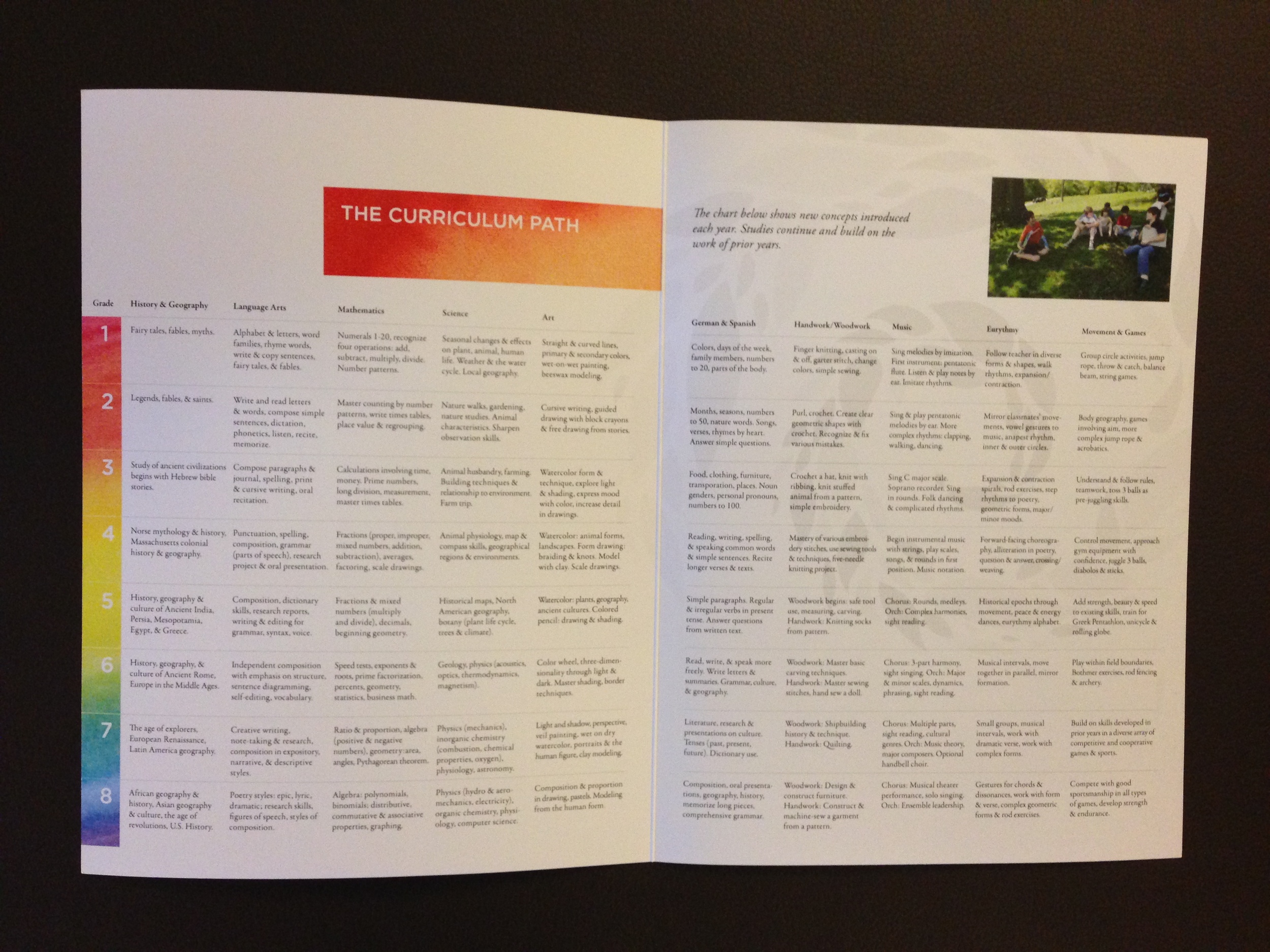
The curriculum of a Waldorf school is based on a certain view of the stages of human development, deriving from the insights of Rudolf Steiner. The consciousness of the child changes in its nature and qualities in very specific ways as the child grows older, changing in tandem with corresponding physiological development. The curriculum thus springs out of the nature of the child, seeking to bring the content which is right for each age, and in an appropriate form.
It is through the capacities of thought, of feeling, and of will that as human beings we bring our individuality to play in living and acting in the world. The main concern of this education is to try to bring balance and harmony to the interplay of these capacities so that students may better be able to live fruitfully and effectively as adults. The art of education lies in finding the ways to accomplish this.
In broad strokes, each of the four years in the high school curriculum embodies an underlying theme and method that helps guide students not just through their studies of the world, but through their inner growth as well. Obviously, these themes and methods are adapted to each specific group of students and take account of the fact that teenagers grow at their own pace. And yet, one can identify struggles common to most any teenager. Even though adolescents pass through developmental landscapes at varying speeds, they nonetheless have to cover similar terrain.
One can summarize the curriculum by grade in the following way:
- Grade 9 trains the student’s power of observation with the question: What?
- Grade 10 trains the student’s power of comparison with the question: How?
- Grade 11 trains the student’s power of analysis with the question: Why?
- Grade 12 trains the student’s power of synthesis with the question: Who?"
Click here and scroll to the bottom of the page for more specifics on the Waldorf High School curriculum by grade level.